Accessibility as standard
A WCAG audit that became a practice-wide framework, adopted by NFU Mutual and Santander.
Focus / Skipton
Where it all began
Skipton Building Society raised a concern. The second release of their customer fact-find application wasn't meeting WCAG accessibility guidelines to the standard they expected. As the most experienced person on accessibility within Focus, I offered to assess the product and work with the team to address it. What I built to do that is still in use across the practice.
What the product was failing on
The fact-find was a multi-step digital journey used by financial advisers and their clients ahead of advice meetings. It covered personal details, financial circumstances, and attitude to risk across four steps. On paper, accessibility had been considered. In practice, it hadn't been applied correctly.
A detailed audit across the full journey surfaced more than 30 issues. Heading structure was broken throughout, with levels skipped or missing entirely, making the journey difficult to navigate for screen reader users. Colour contrast failed on multiple interactive elements including progress indicators and form inputs. Focus states were missing or invisible on key buttons. Form fields lacked proper labels. ARIA attributes were either absent or incorrectly applied. The risk questionnaire had a critical screen reader problem: after selecting an answer and pressing Next, focus stayed on the button rather than moving to the next question, leaving blind users unable to proceed without knowing why.
These weren't edge cases. They were failures across the core journey.
Early interviews and observation sessions revealed something the system hadn't been designed around: users came to the service with three completely different types of tasks. Doing: approve today's batch. Finding: locate a specific payment in response to an enquiry. Checking: scan for anything that needs attention, without knowing in advance whether anything does. The service treated all three the same way. It shouldn't have.
Two things that made the difference
1. A structured audit that gave the team something to work with
The existing approach to accessibility at Focus relied on automated testing: checks that confirmed whether attributes were present, not whether they were correct or meaningful. A missing alt tag would fail. An alt tag that said "image" would pass. That gap needed closing.
I built a WCAG 2.1 AA audit framework from scratch: structured tests across technical compliance, navigation, controls, visual design, forms, content, and screen reader behaviour. Each test had clear pass, fail, and warning criteria mapped to specific WCAG criteria. I worked through it with the Skipton development team issue by issue, distinguishing between design fixes, development fixes, and decisions to risk-accept, and helping them understand why each issue mattered rather than just what needed to change.
Katherine White, the project lead, wrote afterwards: "Ross is an SME on this subject and helped the team to understand the wider context and importance of accessibility as well as the specifics that we should consider for our application. The completed audit was shared with the customer, who gave very positive feedback and felt it demonstrated how seriously we took accessibility."
2. Role-specific guidance that made accessibility stick
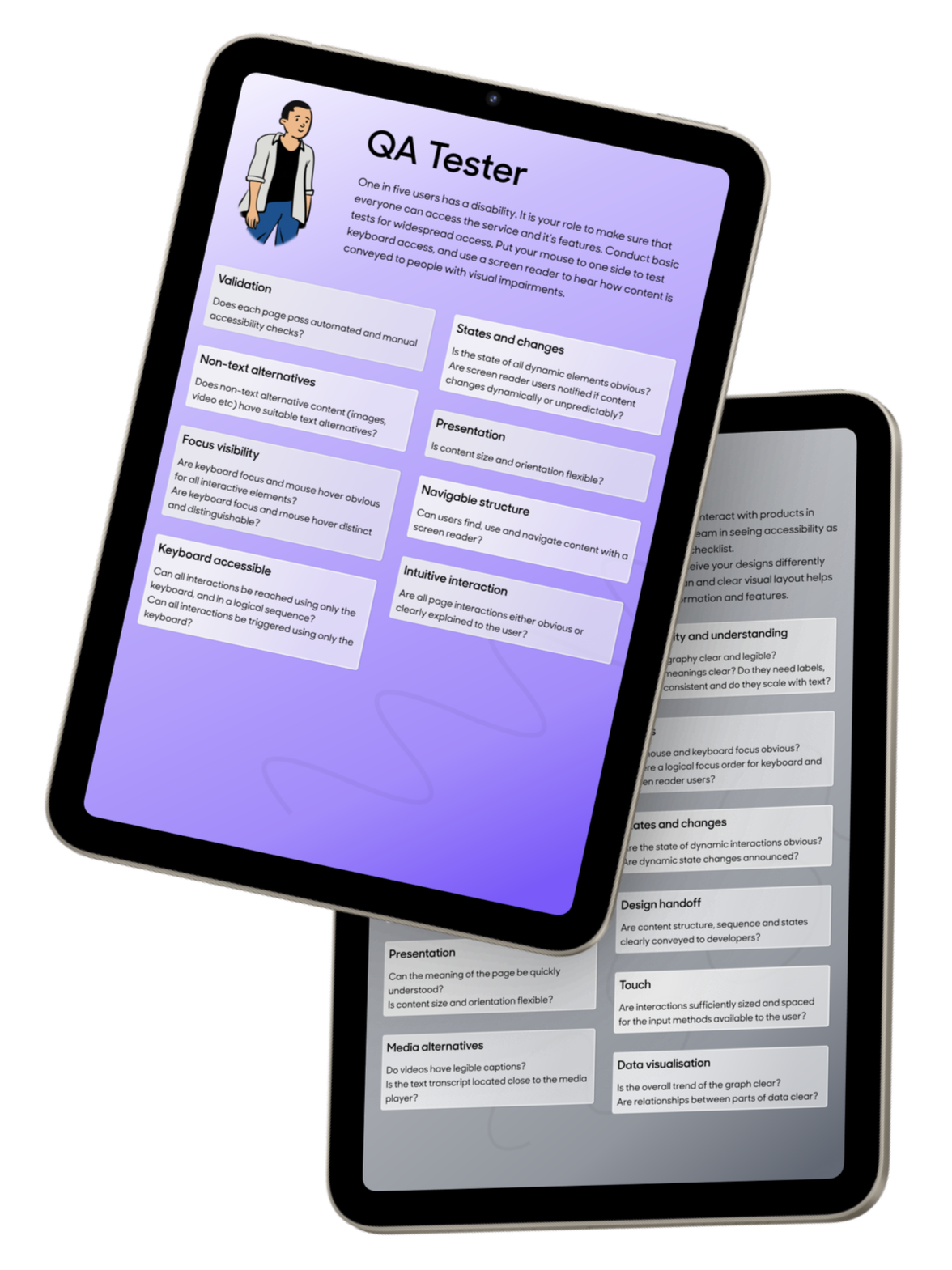
Fixing Skipton's product was one thing. Making sure it didn't happen again was another. I developed accessibility guidance tailored to each role on a product team: separate checklists for designers, developers, content designers, QA testers, and product managers. Each one focused on what that role specifically needed to think about, rather than presenting WCAG as a single standard for everyone to interpret.
One colleague wrote after working through the materials: "Thanks to Ross — for helping me see that accessibility isn't just about ticking boxes, which I think will stand me in good stead in future roles."
What it became
The audit framework is now standard practice on core products at Focus and has been used on client engagements with NFU Mutual and Santander. An approach built for one project became the way the practice handles accessibility.