Making complex advice legible
Turning a portfolio optimisation engine into a client-facing journey. Winner of the EATT Battle of the Tech prize 2024.
Focus
The Focus Advice Engine can analyse a client's entire portfolio across risk, costs, tax efficiency and fund quality, then calculate the mathematically optimal set of changes to make. The problem was that nobody outside of a technical environment could make sense of what it was telling them. The output was a transaction list. For a complex portfolio it could run to hundreds of lines of fund sells, account transfers and money movements.
I designed the journey and UI that turned those transactions into a client conversation. The first public showing won the Battle of the Tech prize at the EATT 2024 conference. It is now in active use at Skipton Building Society.
Battling complexity
What I started with
The engine's output is a list of transactions. What to sell, what to buy, which money moves between which accounts, in what order, to achieve the mathematically optimal portfolio under the defined rules. The calculation is rigorous and provably correct. But a list of hundreds of transactions is not something an adviser can walk a client through. It is not something a client can understand or give informed consent to.
My job was to look at what those transactions achieved, understand the story behind them, and design a way to tell it. What does each movement accomplish? Why does it matter? What does the client's situation look like before, and after?
The answers became a seven-step journey.
What I designed
The journey opens by recapping what has already happened: the initial conversation, the goals, the fact-find. This is the adviser and client sitting down together. The tool is a shared screen. Before anything moves, the client knows what today is for.
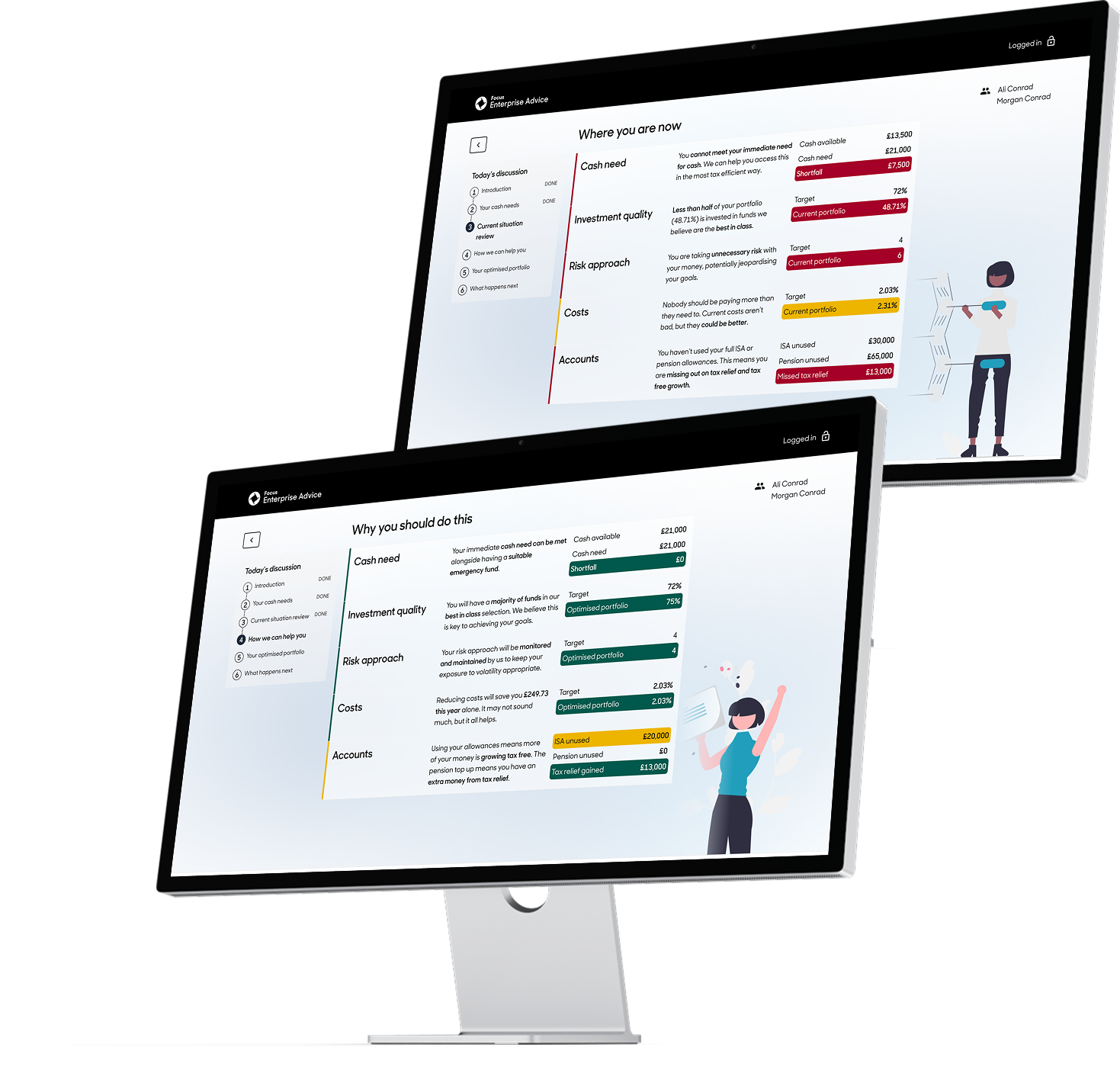
The structure I designed around the engine's outputs is a before and after comparison. Before showing any recommendation, the journey shows the client where they are now. This was a deliberate choice. A client looking at a screen full of new accounts and money movements, without first understanding what was wrong with their current position, has no frame of reference for what the changes achieve. The "oh yes" moment only lands if you have already shown them the problem.
To present the client's current position, I developed a framework of five dimensions: cash position; investment quality; risk level; costs and tax allowances. I spoke to stakeholders inside Focus to understand what the calculation was optimising for, then spoke informally with financial advisers and advice clients to understand what actually landed in client conversations: what they asked about, what they understood, what they reacted to. Each dimension is shown as current reality versus desired position: where the client is now, and what it should be. These are each given a RAG status to be as explicit as possible.
While the current situation is displayed, the engine runs. When it completes, the same screen reappears, showing the same five dimensions in the same layout, but with the RAG statuses updated to show what has improved. The client can switch between before and after directly. Not everything will turn green every time. This is an optimisation engine, not a miracle worker. What it shows is the honest best case under the defined rules and constraints. The optimised portfolio then walks through each product, with diagrams showing exactly where funds are coming from and going to, so the client can see the story behind each change rather than just approve a list.
What it became
Skipton Building Society was the first firm to use the Advice Engine with the UI. Jo Barwick, at Skipton, described it as "an absolute game changer for our ability to help more customers with their longer-term financial goals." The firm has seen a 60% reduction in time to prepare advice and an 80% reduction in case checking since implementation.
The award was given to Focus as a company. But without the journey and UI, there was nothing to demo at EATT. A calculation engine nobody can read is a calculation engine nobody will use.